
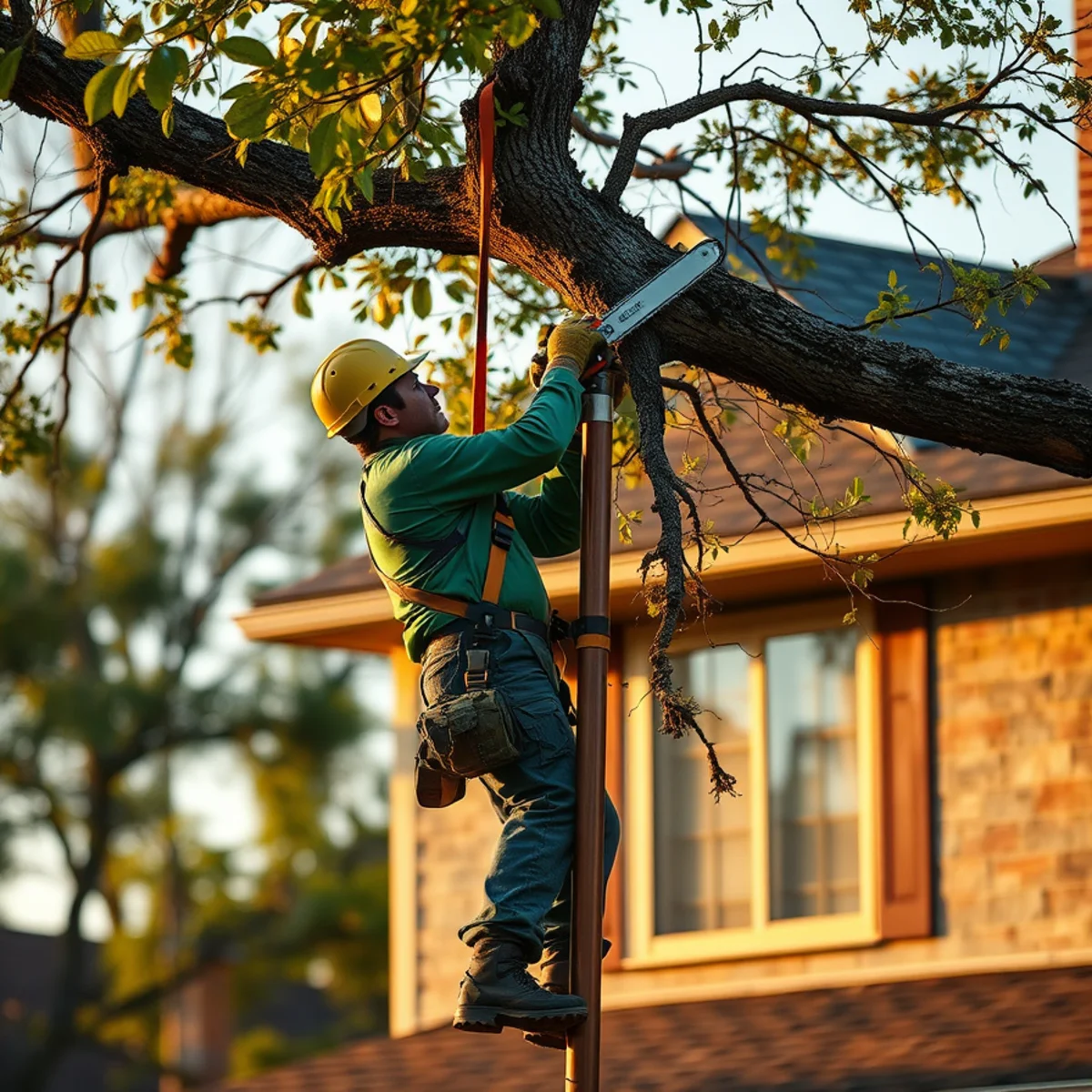
Tree Limb Removal in Fort Worth, TX
Tree Limb Removal in Fort Worth gets dangerous, dead, and overhanging branches off your home before they cause damage or injury. At Sion Tree Service, we take down cracked limbs from spring storms, deadwood that threatens your roof, and branches crowding your fence or power lines, then haul every piece away so your yard looks better than when we arrived.
Tree Limb Removal in Fort Worth gets dangerous, dead, and overhanging branches off your home before they cause damage or injury. At Sion Tree Service, we take down cracked limbs from spring storms, deadwood that threatens your roof, and branches crowding your fence or power lines, then haul every piece away so your yard looks better than when we arrived.
A single heavy limb hanging over a bedroom or driveway is a real hazard in North Texas, where high winds, hail, and the weight of ice from a hard freeze can snap it without warning. Our trained climbers make clean, controlled cuts that protect the rest of the tree and everything underneath it, and our owner Edgar stands behind every job with honest pricing and same-day or next-day response when we can manage it.
What's Included
- Free on-site assessment of each limb and the safest way to remove it
- Removal of dead, diseased, broken, and storm-cracked branches
- Clearance pruning to lift limbs off roofs, gutters, and siding
- Cutting back branches crowding fences, driveways, and walkways
- Reducing limbs that overhang power and service lines where it is safe to do so
- Rigging and lowering heavy limbs by rope to protect what's below
- Proper branch-collar cuts that help the tree seal and recover
- Complete cleanup and haul-away of all wood, brush, and debris
- Three-cut drop method on heavy limbs (undercut, top cut, then collar cut) so the bark does not tear a strip down the trunk
- Removal of widow-makers, the broken limbs already hung up in the canopy that wind can drop without warning
- Tarping and ground protection over pools, AC condensers, septic lids, and flower beds before any limb comes down
- Tool sterilization between cuts and wound dressing on oak species during the February-through-June oak wilt window
- On-request crane-assisted or bucket-truck rigging for limbs too high or too heavy to reach by climbing line
When to Call for Tree Limb Removal
- A limb is cracked, split, or hanging after a storm and could fall at any time
- Dead or bare branches sit directly over your roof, driveway, or play area
- Limbs are scraping the house, lifting shingles, or clogging the gutters
- Branches are growing into or rubbing against power or service lines
- Low-hanging limbs block your driveway, fence line, or walkway
- You hear cracking, popping, or see a fresh split at a branch union after a North Texas wind or hail event
- A spring or summer drought has left a normally green limb suddenly bare or shedding bark on a post oak or red oak
- A heavy horizontal limb over the house has a visible crack in the branch collar or a seam of dark, oozing wood
- Squirrels, gutters, or a re-roof crew have exposed dead wood directly above an entry door, patio, or driveway
Why Tree Limb Removal Pays Off
Protect your home and family
Dead and cracked limbs over a roof, deck, or walkway are the ones that fall first in a storm. Removing them now is far cheaper than repairing a caved-in roof or a smashed vehicle later.
Clean cuts that heal
We cut at the branch collar using proper pruning technique so the wound seals naturally instead of rotting. Sloppy flush cuts and torn bark invite decay and pests into an otherwise healthy tree.
Same-day and next-day response
When a limb is hanging or already down, you don't have weeks to wait. We answer the phone and move fast, often getting to Fort Worth properties the same day or the next.
Spotless cleanup, every time
We rake, blow, and haul away every branch, twig, and wood chip. When we pull out, it looks like we were never there, with no piles left for you to deal with.
Honest, upfront pricing
The number we quote is the number you pay. No surprise add-ons once the truck is in your driveway and no pressure to remove the whole tree when one limb is the problem.
Fully licensed and insured
Limb work near power lines, fences, and rooftops carries real risk. We carry insurance and use well-maintained equipment so the liability never lands on you.
How Our Tree Limb Removal Works
Free estimate
We come out, look at each limb, and give you a clear written quote on the spot. We tell you which branches actually need to go and which can wait.
Plan the cut
We map out rigging points, drop zones, and any power lines or structures below, then protect your roof, fence, and landscaping before a single cut is made.
Safe removal
Our climbers make controlled cuts at the branch collar and lower heavy limbs by rope so nothing hits your home, vehicles, or beds below.
Full cleanup
We chip the brush, haul off every piece of wood and debris, then rake and blow the area so it looks better than when we started.
What Drives Your Tree Limb Removal Cost in Fort Worth
The price depends on how high and heavy the limb is, how close it sits to a roof, fence, or power line, and whether we need to rope and rig it down rather than drop it freely. A few deadwood branches off a low tree cost far less than a large storm-cracked limb hanging over your house. We give free estimates with honest, upfront pricing, so you'll know the full cost before any work begins.
Height and reach of the limb
A low deadwood branch a climber can reach off a single line costs far less than a limb 40 or 50 feet up that needs a bucket truck or crane-assisted rigging to reach safely.
Weight and rigging difficulty
A heavy horizontal limb that must be roped and lowered in sections to clear a roof, fence, or pool takes more time and gear than one that can simply be cut and dropped to open lawn.
Proximity to structures and lines
Limbs hanging over a roof, deck, vehicle, or near the Oncor service drop require slower, controlled lowering, which raises the cost compared to a limb over open ground.
Species and oak wilt timing
Oak limbs cut during the February-to-June risk window add tool sterilization and immediate wound sealing, and dense hardwoods like live oak and mesquite are heavier and slower to cut than soft species.
Storm conditions and access
Emergency same-day response after a derecho or ice event, night work, or a backyard with no equipment access all add labor compared to a scheduled daytime job with an open driveway.
Volume of debris and haul-away
One or two branches chip quickly, while a large storm-cracked limb produces a trailer of brush and wood to chip and haul, and seasoned oak or mesquite worth saving for firewood may change the math.
The local details most companies skip — what every Fort Worth homeowner should understand about tree limb removal before the work begins.
Power Lines, Storm-Cracked Limbs, and Who Is Responsible in Fort Worth
The most dangerous limb-removal calls we get in Tarrant County involve branches tangled up with Oncor lines after a spring storm, and homeowners are usually unsure who is even allowed to touch them. Knowing the dividing line before you climb a ladder or hire anyone protects both your safety and your wallet.
Service drop versus primary lines
The line running from the utility pole to the weatherhead on your house is the service drop, and that lower-voltage section is generally the homeowner's responsibility. The high-voltage primary lines strung pole to pole belong to Oncor, and only their line-clearance-certified vegetation crews may work close to them. We prune and clear limbs around the service drop and flag anything that needs the utility to de-energize or respond first.
- Limbs are kept roughly 10 feet off primary pole-to-pole lines and about 7 feet off secondary lines under Oncor's standard
- If a limb is on the primary, Oncor can perform a Make Ready Prune at no charge, but their contractor is allowed to leave every cut piece on your lawn
- For work near the service drop, Oncor can arrange a temporary disconnect and reconnect so the limb comes down safely
- Never run a pole saw or aluminum ladder near any line, energized or not, after a storm has shifted the branches
On the free estimate we walk the line ourselves, show you which limbs are ours to legally cut and which belong to the utility, and coordinate the timing so the hazard over your house does not sit there for weeks.
Proper Limb Cuts That Protect the Tree, the Climber, and What Is Below
A limb can be removed in a way that heals over cleanly or in a way that rots the trunk and breeds the next failure, and the difference is technique. On a mature post oak, live oak, or pecan, a torn or flush cut is an open invitation to decay, borers, and oak wilt in the North Texas climate.
The three-cut method and the branch collar
For any limb heavy enough to tear, our climbers make an undercut a foot or so out, a top cut just beyond it to drop the weight, then a final cut at the branch collar, the slightly swollen ring where limb meets trunk. Cutting at the collar, not flush to the bark and not leaving a long stub, lets the tree wall off the wound and seal it on its own.
- Heavy limbs over a roof, pool, or fence are roped and lowered in controlled sections, never free-dropped onto what is below
- Widow-makers, the broken limbs already hung in the canopy, are rigged down first because they are the ones that drop without warning
- On oaks cut between February and June, saws are sterilized between trees and the wound is sealed immediately to guard against oak wilt
- Where one side has lost a major limb, we consider reduction pruning or cabling and bracing instead of leaving the tree unbalanced
Expansive clay soil and repeated drought-then-deluge swings in DFW already stress root plates and weaken branch unions, so clean cuts that let a tree recover matter more here than in milder climates. We cut to keep your tree standing strong, not just to get the branch off the ground.
How to Vet a Fort Worth Tree Crew Before a Climber Leaves the Ground
Storm season brings out-of-town crews and door-knockers who chase hail and wind damage across the DFW metroplex, and limb work near homes and lines is exactly where an uninsured operation can cost you dearly. A few minutes of homeowner due diligence separates a real arborist from a chainsaw and a pickup.
- Ask for current proof of both liability and workers' compensation insurance in writing, so an injured climber or a dropped limb never becomes your liability
- Confirm the written quote includes full haul-away, since legitimate crews clean up and only utility line-clearance contractors leave the debris behind
- Be wary of pressure to remove or top a whole tree when one limb is the hazard, and of any large cash deposit demanded before work begins
- For oak work, ask directly how they handle oak wilt timing and tool sterilization, because a knowledgeable local crew will answer without hesitating
- Get a clear written scope listing exactly which limbs come off and how cleanup and stump or brush will be handled
Sion Tree Service is a locally owned, licensed and insured outfit run by owner Edgar, with trained climbers, well-maintained and properly rigged equipment, and 146 real Google reviews near a 4.9 average. We quote honestly, the quoted price is the final price, and we haul every piece away so your only evidence we were there is the missing hazard.
Smart Homeowner Tips Before You Hire Anyone
A few habits that protect your wallet, your property, and your insurance claim — whether you hire us or not.
Get a dead or cracked limb over your roof down before the next spring hail and wind line moves through, not after it has already punched through the shingles.
Always ask any tree company for proof of liability and workers' comp insurance in writing before a climber leaves the ground on your property, so a fall never becomes your lawsuit.
Watch for the three-cut method on heavy limbs, an undercut first, then a top cut, then the final collar cut, because a single top-down cut tears bark and opens the trunk to decay.
Be skeptical of anyone who wants to top a whole tree or remove it when one bad limb is the actual hazard, since topping invites weak regrowth and future widow-makers.
Confirm the crew sterilizes saws and paints the cut when working any oak between February and June, the high-risk window for spreading oak wilt through fresh wounds in North Texas.
Check that the quote includes full haul-away in writing, because Oncor's own line-clearance contractors are allowed to leave all the cut debris piled on your lawn.
Tree Limb Removal Across Fort Worth & DFW
Serving Fort Worth and the surrounding Dallas–Fort Worth metroplex, seven days a week.
Fort Worth neighborhoods we work in often:
Trusted by Local Homeowners
“Sion Tree Service did an outstanding job trimming the trees at my home. The crew of 6 came in and quickly removed all the dead limbs and trees that needed to come out. Their cleanup was amazing! Highly recommend them!”
“Very fast work, arrived right on time, workers very professional and cleaned up before leaving. The price was what was quoted. I'd recommend them to anyone needing tree trimming. I'll be using them again!”
“Great communication and super responsive. Squeezed me in the next day and did an awesome job removing and grinding a large tree that had fallen in a storm. Have used them twice with great service both times.”
Tree Limb Removal FAQs
Branches touching the high-voltage lines on the poles are owned by the utility and must be handled by them. We can safely remove limbs around the service line running to your house and clear branches that threaten the lines, and during the free estimate we'll tell you exactly which is which.
Just the limb is usually fine. If a tree is structurally sound but has a few dead, cracked, or overhanging branches, targeted limb removal is the right call. We'll only recommend full removal if the tree itself is a hazard, and we'll explain why.
Done right, no. We cut at the branch collar so the wound seals properly. We are also careful with oak wilt season in North Texas and generally avoid pruning oaks from February through June unless a limb is an immediate hazard, in which case we seal the cut right away.
Often the same day or the next, especially after a storm. A hanging or cracked limb is a safety issue, so we prioritize it. Call us at (208) 635-2100 and we'll let you know the soonest we can be there.
Yes, every time. We chip the brush and haul away all the wood and debris as part of the job. When we leave, your yard is raked and blown clean, with no piles left behind for you to deal with.
Oncor's clearance standard keeps limbs roughly 10 feet off the primary pole-to-pole lines and about 7 feet off the secondary lines, and only line-clearance-certified crews may work within a few feet of the energized primary. We can prune limbs around the lower-voltage service drop that runs from the pole to your house and clear branches threatening it, and on the estimate we'll show you which limbs are ours to cut and which belong to the utility. If a primary line is involved we'll point you to Oncor so they can de-energize or send their vegetation crew first.
Routine limb removal and pruning on your own residential lot generally does not require a city permit, since the Fort Worth tree ordinance is aimed at removing or heavily impacting protected and heritage trees, often on commercial or development sites. We work within those rules and will flag it if a tree on your property looks large or protected enough to warrant a call to the city forester. We never invent fees, and a free estimate is the right moment to sort out whether anything needs a permit.
Many homeowner policies cover limb removal when a branch has actually struck or damaged a covered structure like the roof, fence, or a vehicle, while purely preventive trimming of a healthy tree usually is not covered. Take dated photos before we touch anything and keep our written estimate and haul-away receipt, because carriers ask for that documentation. We are happy to work alongside your adjuster's timeline so the dangerous limb comes down fast without jeopardizing your claim.
A limb that is cracked, hung up in the canopy, or near any line is exactly the kind that kills do-it-yourselfers every storm season, because it can swing, kick back, or drop the moment the holding wood lets go. The weight of a water-soaked or ice-loaded branch on North Texas clay-rooted trees is far greater than it looks from the ground. Trained climbers rig and lower these limbs under control, which is why this is the one job worth handing to an insured crew.
Removing one heavy limb correctly, with a clean branch-collar cut, will not harm a structurally sound tree, and on oaks we time the work around oak wilt season and seal the cut when needed. If a tree has lost a major limb on one side, we look at whether reduction pruning on the heavy side or a cabling and bracing setup is the smarter long-term fix rather than just topping it. We'll tell you honestly when a single cut solves the problem and when the tree needs a broader plan.
Related Tree & Yard Services
Tree Trimming
Expert tree trimming for healthier growth, better curb appeal, and safer clearance.
Learn MoreEmergency Tree Removal
Fast same-day response for fallen, leaning, or storm-damaged trees in Fort Worth.
Learn MoreTree Removal
Safe removal of dead, storm-damaged & large trees, with full cleanup and haul-away.
Learn MoreReady for Tree Limb Removal in Fort Worth?
Call Sion Tree Service for tree limb removal done safely, affordably, and cleanly — with a free, no-obligation estimate.
Open daily 6 AM–7 PM · Serving Fort Worth & the DFW metroplex